
This meticulous record-keeping fosters trust among investors, creditors, and stakeholders, as they can have confidence in the integrity of the financial statements. The accounting equation describes the relationship that exists between the assets and liabilities of a company, in addition to the owner’s equity. The accounting equation is built upon three primary components, each representing a distinct aspect of a business’s financial structure.
How Transactions Impact the Equation

Assets represent everything a company owns, liabilities are its obligations, and equity is the residual interest of the owners. Equity, often referred to as Owner’s Equity or Stockholder’s Equity, represents the owners’ residual claim on the assets of the business after all liabilities have been satisfied. Components of equity include owner’s capital (initial investment made which three components make up the fundamental accounting equation by the owner) and retained earnings (profits accumulated by the business that have not been distributed to owners). For corporations, equity also includes common stock, representing the value of shares issued to investors.
Understanding the Equation’s Components
If an owner contributes $10,000, the asset side rises by $10,000, and owner’s equity also increases by $10,000, leaving the equation in balance. Each transaction, regardless of https://miacalculadoraalicia.com/is-bookkeeping-certification-worth-it-salary-and/ its complexity, is meticulously recorded to ensure that the fundamental accounting equation consistently remains in perfect balance. The accounting equation must always remain in balance, meaning that the total value of assets will consistently equal the combined total of liabilities and equity.

Strengthening Financial Management with the Accounting Equation

The accounting equation emphasizes a basic idea in business; that is, businesses need assets in order to operate. First, it can sell shares of its stock to the public to raise money to purchase the assets, or it can use profits earned by the business to finance its activities. Second, it can borrow the money from a lender such as a financial institution. Equipment examples include desks, chairs, and computers; anything that has a long-term value to the company that is used in the office.
- The total value of all assets must match the combined total of all liabilities and equity.
- Overall, the accounting equation underpins financial transparency, serving as the foundation for thorough and reliable reporting.
- Since there are no liabilities, all funds come from the owner’s equity, keeping the equation balanced.
- In this form, it is easier to highlight the relationship between shareholder’s equity and debt (liabilities).
- This section delves deeper into the relationship between double-entry bookkeeping and the accounting equation.
- On the other hand, double-entry accounting records transactions in a way that demonstrates how profitable a company is becoming.
Not All Transactions Affect Equity
- With a robust system, businesses can maintain balanced records effortlessly while focusing on growth and efficiency.
- At the point they are used, they no longer have an economic value to the organization, and their cost is now an expense to the business.
- Assets, liabilities and owners’ equity are the three components that make up a company’s balance sheet.
- Components of equity include owner’s capital (initial investment made by the owner) and retained earnings (profits accumulated by the business that have not been distributed to owners).
- By properly managing these elements, businesses can optimize resources, enhance profitability, and sustain long-term growth.
The Accounting Equation is a fundamental principle that states assets must equal the sum of liabilities and shareholders equity at all times. In this form, it is easier to highlight the relationship between shareholder’s equity and debt (liabilities). As you can see, shareholder’s equity is the remainder after liabilities have been subtracted from assets. This is because creditors – parties that lend money such as banks – have the first claim to a company’s assets. Analyzing changes in the accounting equation helps businesses and analysts understand the impact of different financial activities.
Importance of the Accounting Equation in Financial Management
- These retained earnings are what the company holds onto at the end of a period to reinvest in the business, after any distributions to ownership occur.
- When a business uses cash to purchase equipment, one asset (cash) decreases, while another asset (equipment) increases by the same amount.
- The dividend could be paid with cash or be a distribution of more company stock to current shareholders.
- One of the light-shedding problems with the accounting equation is its consideration of variables at historical cost.
- Therefore, opting for well-known bookkeeping services is important to avoid calculation and posting errors.
- This clear and balanced presentation is essential for financial analysis, providing insights into a company’s solvency and overall financial health.
- It provides a clear snapshot of what a company owns, what it owes, and what belongs to its owners.
Recall, too, that revenues (inflows as a result of providing goods and services) increase the value of the organization. So, every dollar of revenue an organization generates increases the overall value of the organization. If a company’s assets were hypothetically liquidated (i.e. the difference between assets and liabilities), the remaining value is the shareholders’ equity account. The accounting equation is a core principle in the double-entry bookkeeping system, wherein each transaction must affect at a bare minimum two of the three accounts, i.e. a debit and credit entry.
It explains how every financial transaction is recorded in a way that keeps the assets, liabilities, and equity in balance. Double-Entry Bookkeeping is a method of recording financial transactions where each transaction is recorded in at least two accounts – a debit and a credit. This system ensures that the accounting equation remains in balance, as each transaction affects both sides of the equation equally. When a business uses cash to purchase equipment, one asset (cash) decreases, while another asset (equipment) increases by the same amount.

The company owing the product or service creates the liability to the customer. A company’s “uses” of capital (i.e. the purchase of its assets) should be equivalent to its “sources” of capital (i.e. debt, equity). Regardless of how the accounting equation is represented, it is important to remember that the equation must always balance. In order for the accounting equation to hold, Total Assets should ideally be equal to the sum of Total Liabilities and Total Equity. Assets are the resources that are held by the company in order to function and operate in the relevant industry.
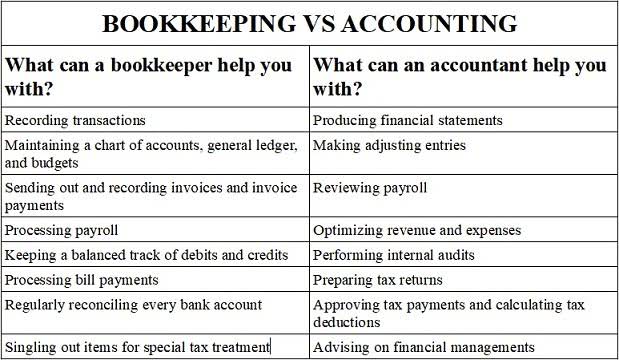
The accounting equation connotes two equations that are basic and core to accrual accounting and double-entry accounting system. These limitations Bookkeeping vs. Accounting highlight the necessity of using the accounting equation in conjunction with other financial analyses to paint a fuller picture of a company’s economic landscape. Assets refer to resources a business owns, such as cash, inventory, property, and investments.